

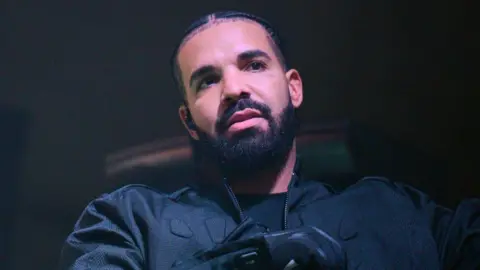
A court official has dismissed Drake's defamation lawsuit against Universal Music Group over Kendrick Lamar’s song the diss record.
Presiding Judge the court’s judge ruled that the rapper’s song lyrics, which claimed Drake and his crew of being "pedophiles", were "nonactionable opinion" and could not be considered libelous.
Drake filed the lawsuit in early this year, accusing Universal Music Group, the record label representing the two rappers, of defamation by allowing the song to be released and marketed, saying it disseminated a "false and malicious narrative".
Drake's representative said he planned to challenge the decision. Universal Music Group expressed it was pleased with the outcome and was looking forward to continuing its collaboration with the musician.
Context of the Rap Battle
The diss song, which was initially released in May 2024, was broadly viewed as the final strike in an ongoing battle between the competing artists.
It has become the biggest hit of the rapper’s musical journey, having received multiple Grammy awards and being one of the most-discussed highlights of his Super Bowl half-time show in February.
In a detailed ruling, the judge called the row between the rappers "the most infamous rap battle in the history of rap music".
"The artists' seven-track rap battle was a 'verbal conflict' that was the subject of extensive press coverage and digital debate," the court noted.

"Although the accusation that Drake is a pedophile is certainly a serious one, the broader context of a heated rap battle, with incendiary language and offensive accusations hurled by both participants, would not incline the reasonable listener to believe that 'the track' imparts truthful statements about the claimant."
She additionally observed that, in an earlier song, Drake had "challenged Lamar to make the paedophilia accusations" that appeared in the diss record.
On the track Taylor Made Freestyle, Drake used the synthetic vocals of Tupac Shakur to suggest strategies on how to win the rap battle.
"Talk about him likin' young girls, that's a gift from me," the track suggested.
"It is in this context in which such lyrics as 'Say, Drake, I hear you like 'em young' must be evaluated," wrote the court.
"The parallel in the wording strongly indicates that this line is a direct callback to the artist’s own words in the prior song."
'A Slap in the Face to Creatives'
The musician, whose real name is Aubrey Graham, did not sue Lamar in the legal filing.
His lawyers alleged the label of initiating "a campaign to generate a viral hit" out of a release that made the "untrue claim that the artist is a criminal paedophile, and to imply that the public should resort to vigilante justice in retaliation".
Ruling against Drake, the judge said fans would not expect "accurate factual reporting" from a musical attack "replete with vulgar language, trash-talking, violent implications, and figurative and hyperbolic language."
She pointed out that the rapper himself had engaged in comparable rhetoric, quoting a line in which the artist "strongly" implied that "his opponent is a domestic abuser", and a separate instance where he "claims that he 'heard' that one of Lamar's sons may not be his biological offspring."
Concerning the track in question, the court said: "Even apparent statements of fact may assume the character of subjective views... when made in open discourse, intense arguments, or similar situations in which an listener may expect the use of slurs, passionate language or hyperbole."
Responding to the dismissal, a label representative said: "From the outset, this lawsuit was an insult to all artists and their creative expression and should not have seen the light of day."
"We're pleased with the court's dismissal and look forward to continuing our work successfully promoting Drake's music and supporting his career," the representative continued.
A representative for the musician said the rapper planned to appeal the decision, "and we look forward to the Court of Appeals examining it".
Kendrick Lamar has yet to comment on the case.


